My blog is about different activities and labs that we do in Mr. Orre's biology class. It will have lots of information regarding science and mainly biology.
Saturday, January 23, 2016
Unit 6 Reflection
Friday, January 22, 2016
pGLO Lab
1.
2. The two new traits that our transformed bacteria have are glowing under UV light and resistance to ampicillin.
3. I estimate that there were about 1000 bacteria in the 100 ul of bacteria that we spread on the plate. Since there were about 200 colonies in our +pGLO Lb/Amp/Ara plate, I estimated that there had to be much more bacteria that hadn't been transformed/not received the plasmid with resistance to ampicillin.
4. The role of arabinose in the plates is to make the bacteria glow under UV light. The arabinose activates the GFP gene which causes the bacteria to glow.
5. Three current uses for GFP in research or applied science are acting as a cell marker, tagging genes for movement of certain cancers, and showing promoter activity. A cell marker can be used to track where bacteria is present and tagging genes can be used to show the movement of certain cancers. GFP can also be used to show promoter activity in operons.
6. Another application of genetic engineering is how plants are altered to express a gene that isn't native to that particular plant or to modify its genes. It can be used to provide resistance to drought or extreme temperature.
3. I estimate that there were about 1000 bacteria in the 100 ul of bacteria that we spread on the plate. Since there were about 200 colonies in our +pGLO Lb/Amp/Ara plate, I estimated that there had to be much more bacteria that hadn't been transformed/not received the plasmid with resistance to ampicillin.
4. The role of arabinose in the plates is to make the bacteria glow under UV light. The arabinose activates the GFP gene which causes the bacteria to glow.
5. Three current uses for GFP in research or applied science are acting as a cell marker, tagging genes for movement of certain cancers, and showing promoter activity. A cell marker can be used to track where bacteria is present and tagging genes can be used to show the movement of certain cancers. GFP can also be used to show promoter activity in operons.
6. Another application of genetic engineering is how plants are altered to express a gene that isn't native to that particular plant or to modify its genes. It can be used to provide resistance to drought or extreme temperature.
Thursday, January 21, 2016
Candy Electrophoresis Lab
1. One dye band was a different size than the reference band. All the dyes were the same colors as the reference bands except for the orange dye. The dye was a bit darker than the reference band. The color difference did not occur in more than one color band. We did not observe any dyes that were moving in the "wrong" direction. These dyes could have had other ingredients in their coloring in addition to the reference dyes causing them to move/look slightly different.
2. Fast green FCF would move similarly to Blue 1 and Citrus red 2 would move similarly to Red 40 because they are similar in size to each other. Fragments of similar size travel together in groups. They move at a similar pace and travel almost the same distance as each other.
3. Dog manufactures put artificial food colors into dog food because they want to make the food look more appealing to their customers and seem less processed. The only reason why they use artificial food dyes is for aesthetic appeal.
5. The two factors that control the distance the colored dye solutions migrate are their length and weight.
6. The positive electrical current helps move the dyes through the gel.
7. Gel electrophoresis causes the molecules to separate by size because the smaller fragments travel further and move faster while the larger fragments travel less and move slower. Fragments of the same size travel in groups and cover the same amount of distance.
8. The DNA molecule with the molecular weight of 600 daltons would move the fastest and the furthest. The next to travel the furthest would be the DNA molecule that weighs 1000 daltons. After that, the molecule with the weight of 2000 daltons, and finally the DNA molecule with the weight of 5000 daltons would travel the least and move the slowest.
2. Fast green FCF would move similarly to Blue 1 and Citrus red 2 would move similarly to Red 40 because they are similar in size to each other. Fragments of similar size travel together in groups. They move at a similar pace and travel almost the same distance as each other.
3. Dog manufactures put artificial food colors into dog food because they want to make the food look more appealing to their customers and seem less processed. The only reason why they use artificial food dyes is for aesthetic appeal.
5. The two factors that control the distance the colored dye solutions migrate are their length and weight.
6. The positive electrical current helps move the dyes through the gel.
7. Gel electrophoresis causes the molecules to separate by size because the smaller fragments travel further and move faster while the larger fragments travel less and move slower. Fragments of the same size travel in groups and cover the same amount of distance.
8. The DNA molecule with the molecular weight of 600 daltons would move the fastest and the furthest. The next to travel the furthest would be the DNA molecule that weighs 1000 daltons. After that, the molecule with the weight of 2000 daltons, and finally the DNA molecule with the weight of 5000 daltons would travel the least and move the slowest.
Wednesday, January 13, 2016
Recombinant DNA Lab
The first step of producing recombinant DNA is to splice open the plasmid. Our plasmid had bacteria that was resistant to ampicillin. We could use ampicillin in our petri dishes to see if bacteria had taken over the plasmid since we had the gene that was resistant to it. We would know if the bacteria had taken our plasmid because if it did then the bacteria would be resistant to the antibiotic and survive. I wouldn't use any of the other antibiotics because our bacteria isn't resistant to any of the others and it would have just killed all the bacteria. After that we tested all of the restriction enzymes to see which ones could splice open the plasmid in one place and the human DNA in two places. Restriction enzymes are bacterial enzymes that recognize a specific nucleotide sequence in DNA molecules and cut the molecules at that sequence. Two of the ones we tested spliced the plasmid and human DNA the correct amount of times. The two enzymes were Eco RI and Hin dIII; however, although both of them worked, the Hin dIII spliced closer to the insulin gene. Therefore, we ended up using the Hin dIII. If we had used an enzyme that cut the plasmid in two places then it would not have joined together with the DNA and it wouldn't have been able to make recombinant DNA. There would have been two extra sticky ends. We then found the areas where the bases of the restriction enzyme and the bases of the human DNA and plasmid had been spliced. The sticky ends then joined with the DNA pieces and formed recombinant DNA. This technology could be important in daily life because it allows the insertion of different genes to give an organism new traits that could possibly prevent/cure certain diseases. A real life example of this technology being used is in the creation of genetically engineered plants that produce a toxin called Bt. It kills off certain crop pests so that farmers' crops don't get eaten away at by insects and have higher success rates.
Tuesday, January 5, 2016
New Year's Goals
My first goal for this semester is to stay more focused and be on track in class. I will make sure to pay more attention in class and spend more time working and doing projects rather than talking to my peers. In order to achieve this goal I will not talk to my classmates when we are given time to do homework in class. I will also listen more carefully to instructions so that I won't have to ask so many questions later which will further help me be more focused.
My second goal for this semester is to not procrastinate and to go to bed earlier. I will start my homework as soon as I get home and not wait until the last minute to do it. By doing my homework as soon as possible, I will get done faster, and then be able to go to bed earlier. I will also use my time wisely while doing homework and just focus on the one assignment I'm working on rather than watching TV or listening to music at the same time.
Wednesday, December 9, 2015
Unit 5 Reflection
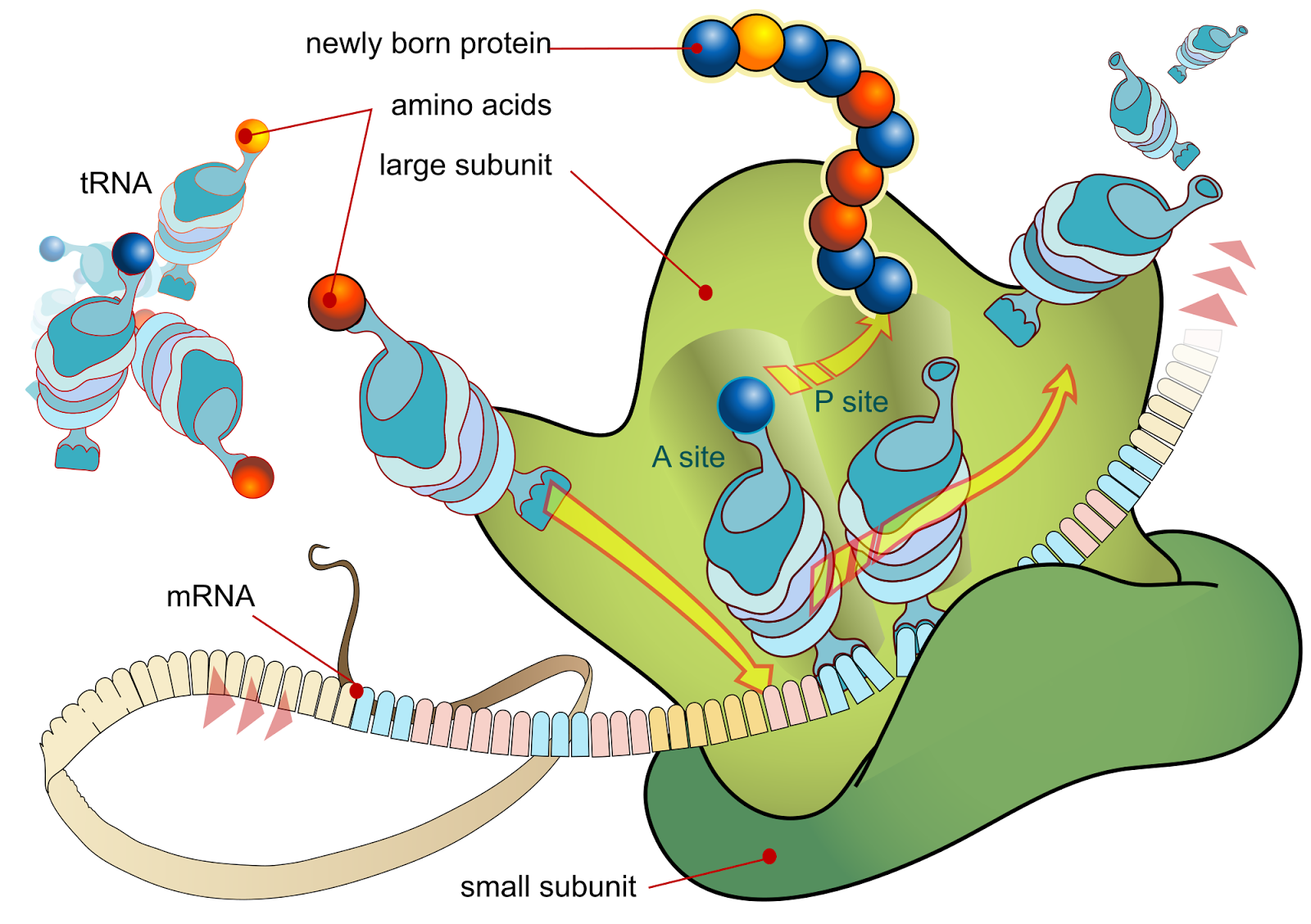
This unit was about protein synthesis and different types of mutations. We also learned about how DNA is copied and gene regulation. Protein synthesis is when protein is made through transcription then translation. The first step of protein synthesis is a section of DNA being copied by an enzyme and producing a copy called messenger RNA. The mRNA then leaves the nucleus and moves to the cytoplasm. The mRNA then bonds bonds with a ribosome, which will make a protein. The ribosome reads the first three bases called a codon and that determines which amino acid will go with that base. The amino acids are bonded together, and when the mRNA is done being translated, the amino acid chain folds up to become a protein. There are many different types of mutations such as substitution, deletion, and insertion. However, the worst possible case would either be an insertion or deletion in the very beginning of the sequence. It could cause the protein to change drastically and maybe not even start coding until the middle of the sequence, or not start at all. Gene regulation is when the gene prevents itself from being copied by the RNA polymerase. A strength that I have is understanding protein synthesis because of the lab that we did in class. That lab really helped me understand mutations and their effects, but also how the process of protein synthesis works. However, on the other hand, a weakness of mine is understanding gene regulation. Gene regulation is not something that I understand fully yet, and I still have trouble knowing the process of it. I am definitely a better student than I was before this unit because I learned more about these processes in detail, and I think that I can now explain to my peers almost all of the topics of this unit. I want to learn more about mutations and the conditions/diseases they cause because I think it's so interesting how one extra amino acid added or taken out can cause such a big change to the protein. An unanswered question that I still have is how complicated gene regulation can get in humans. I still wonder about how many mutations can be caused in one sequence of bases or whether there is a limit to as how many can occur or not.
According to the Vark Questionnaire, I learned best when I listened to other people talking and when I saw diagrams and pictures. Because of this new information, I studied playing to my strengths and it actually helped me a lot. I did pretty well on the test and it the most recent test actually ended up being my highest test score. I learned that studying by looking at pictures and listening to vodcasts really helped me soak in all the information. I will definitely study like I did for the most recent test for the upcoming final.
Tuesday, December 8, 2015
Protein Synthesis Lab
In order to make a protein, the gene first has to be transcripted. A section of DNA, or a gene, is copied by an enzyme. The copy that is produced is called messenger RNA, or mRNA. The mRNA then leaves the nucleus and travels to the cytoplasm. Then, the copy is used to make a protein in a process called translation. The mRNA bonds with a ribosome to make a protein. The ribosome then reads the first three bases called a codon, and determines which amino acid will correspond with that specific sequence. Each amino acid that is added is determined by the codon read by the ribosome. The amino acids are bonded together and when the mRNA finishes translating, the amino acid chain folds up and becomes a protein.
The mutation that seemed to have the greatest effect in our lab was deletion, and the mutation that seemed to have the least effect was substitution. During some cases, substitution can cause no change to the amino acids determined and the protein can stay the same. However, in other cases, substitution can cause the protein to change a lot. Insertion could also cause very similar effects as deletion. It is very important where the mutation occurs. If it happens near the beginning of a sequence, then it could become very harmful, whereas if it happened near the end, there would be less of an effect. It would be different if the T that we substituted for C were near the end of the sequence because then it would have caused less amino acids to change; therefore, leaving the protein mainly unchanged.
When we got the chance to choose our mutation, I chose deletion because I wanted to see how much it would change if I deleted the very first base in the sequence and then again later on. This mutation was different than the others ones we tried because this sequence didn't even start coding until near the middle of the bases. There was no "met" amino acid to tell the ribosome to start coding until it got to the middle of the sequence. It does matter where the mutation occurs because if I hadn't changed the first base and say I changed the last, then the protein would have had a start codon in the beginning.
If proteins make our bodies work, and proteins are determined by the sequence of amino acids, a mutation could affect my life by causing a disease and my body potentially not behaving correctly. There could be a serious disease caused by one single base being inserted, missing, or substituted that could alter the function of my whole body. An example of a disease caused by a single mutation is Tay-Sachs disease. It is very rare, inherited disease that causes the destruction of nerve cells in the brain and spinal cord. Symptoms usually appear from around six months old, and there is no cure. The disease is inherited in an autosomal recessive pattern.
The mutation that seemed to have the greatest effect in our lab was deletion, and the mutation that seemed to have the least effect was substitution. During some cases, substitution can cause no change to the amino acids determined and the protein can stay the same. However, in other cases, substitution can cause the protein to change a lot. Insertion could also cause very similar effects as deletion. It is very important where the mutation occurs. If it happens near the beginning of a sequence, then it could become very harmful, whereas if it happened near the end, there would be less of an effect. It would be different if the T that we substituted for C were near the end of the sequence because then it would have caused less amino acids to change; therefore, leaving the protein mainly unchanged.
When we got the chance to choose our mutation, I chose deletion because I wanted to see how much it would change if I deleted the very first base in the sequence and then again later on. This mutation was different than the others ones we tried because this sequence didn't even start coding until near the middle of the bases. There was no "met" amino acid to tell the ribosome to start coding until it got to the middle of the sequence. It does matter where the mutation occurs because if I hadn't changed the first base and say I changed the last, then the protein would have had a start codon in the beginning.
Subscribe to:
Posts (Atom)